


Google sees an empty page
Some generated apps still ship client-rendered shells that search crawlers cannot reliably read.
Your site looks finished in the builder. Here is how it looks to Google, to a friend on WhatsApp, and to ChatGPT. We show you, then open the fix as a pull request you approve.
GOOGLE WHATSAPP
 CHATGPT
 GoogleChatGPT
 Claude
 Perplexity
 GeminiWhatsApp
 LinkedIn
 Slack
Slack X
XWhat you get
These are the actual screens, captured from a real audit of a live site.
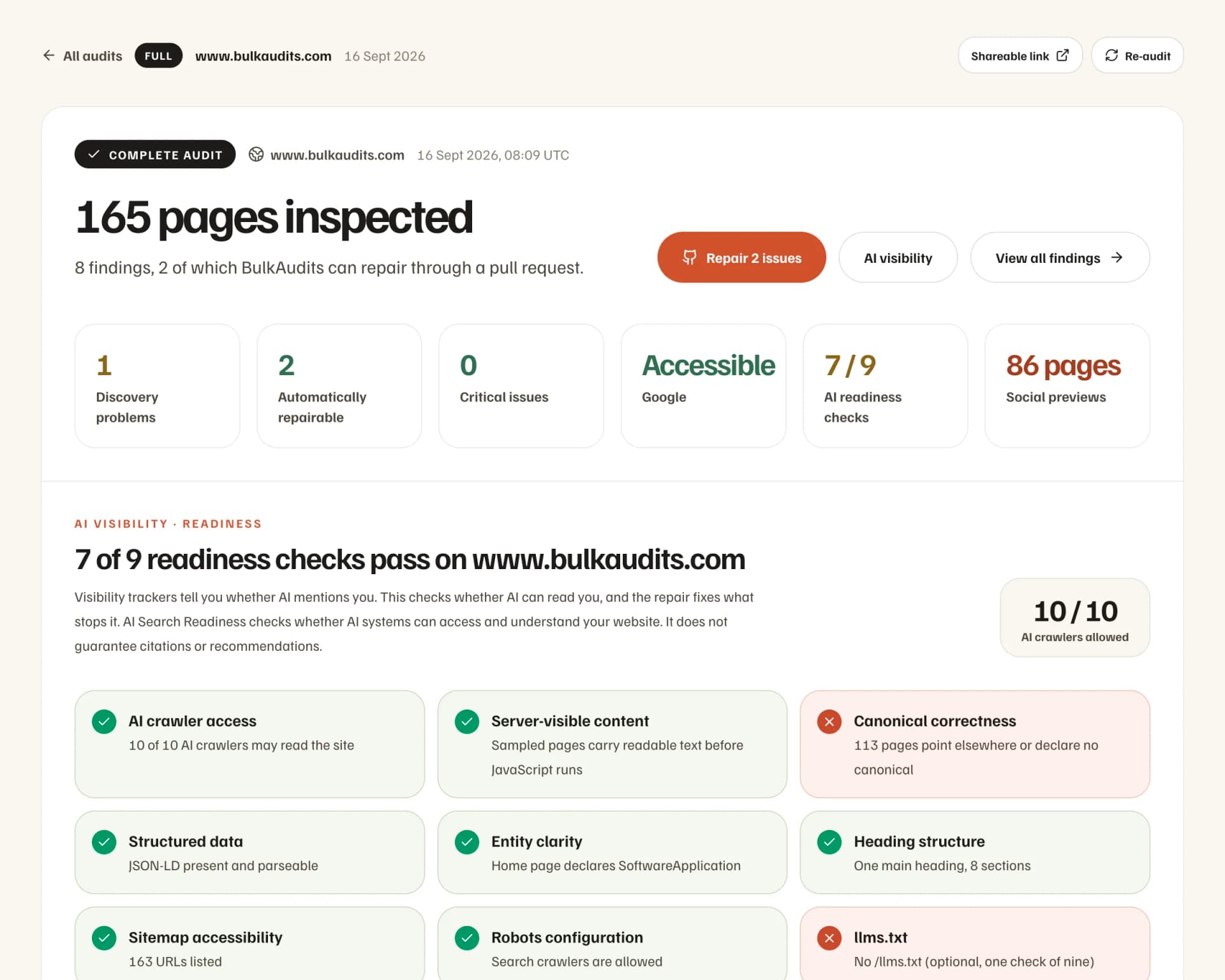
One row tells you where you stand
Pages inspected, findings graded by whether software can fix them safely, and the state of Google, AI readiness and social previews at a glance. Every number links to its evidence.
Looks finished. Is not finished.
A beautiful page can still be unreadable to crawlers, invisible in search, and broken everywhere it gets shared.
Some generated apps still ship client-rendered shells that search crawlers cannot reliably read.
LinkedIn, X, Slack, and WhatsApp find no preview image or useful page description.
Generated components are rewritten constantly, silently dropping metadata you already added.
Builder-aware repairs
We detect what your builder actually generated, use its native metadata system, and refuse unsupported code instead of guessing.
 Lovable
Prompt-by-prompt metadata regressions
See exact repair path Bolt
BoltSEO Boost, domain, and route gaps
See exact repair path v0
v0metadataBase and dynamic route gaps
See exact repair path Base44
Builder, repo, and publish state drift
See exact repair path Replit
Source, build, and live output drift
See exact repair pathAI visibility
Most AI crawlers never run JavaScript and obey robots.txt to the letter. BulkAudits checks the nine things that decide whether they can reach and understand your pages, and reports them next to Google and social, not instead of them.
AI Search Readiness checks whether AI systems can access and understand your website. It does not guarantee citations or recommendations.
GPTBot, OAI-SearchBot, ClaudeBot, PerplexityBot, Google-Extended and five more, read from robots.txt.
Whether real text exists in the initial HTML, or only an empty application shell.
Every page declares itself as the original on the production domain.
JSON-LD present and parseable on the pages that matter.
The home page says what the site is: an organisation, a product, a person.
One main heading and real sections, so extraction has a shape to follow.
A valid sitemap that lists live pages.
Search crawlers allowed and no stray noindex on production.
One check of nine. Present is good; absent is not a crisis.
From URL to merged fix
The audit is the diagnosis. The pull request is the product.
We check what Google and social crawlers actually receive. No account required.
BulkAudits detects the framework and prepares only fixes it can verify safely.
See the before-and-after result. Your site changes only when you approve the PR.
If your builder reintroduces a defect, the watcher catches and repairs it again.
Pricing
There is no free plan; the preview needs an account. Every plan includes complete reports, repair pull requests, tools and saved history. Cancel any time; access runs to the end of the period.
Starter
For founders and single-site operators.
$29 / month
Pro
Most chosenFor freelancers and AI studios.
$79 / month
Agency
For agencies and portfolio operators.
$199 / month
Not another score
Every finding is graded by whether software can fix it safely, not by which Lighthouse tab it belongs to.
Raw HTML, crawler responses, robots, sitemap URLs, canonicals, domain leakage, soft 404s, and redirects.
Can Google receive the real page?
Unique titles, descriptions, Open Graph, Twitter cards, preview images, headings, and document language.
Does every route explain itself?
AI crawler access, server-visible content, canonicals, structured data, entity clarity, headings, sitemap, robots, and llms.txt.
Can AI systems read and understand the site?
LCP, CLS, INP, image sizing, lazy loading, fonts, imports, unused code, and render blockers.
Does the generated code stay fast?
Image alternatives, colour contrast, form labels, and accessible names for interactive controls.
Can every visitor use it?
Lovable removed the pricing page description
Previously fixed 6 days ago · repair prepared in 12 seconds
Repair PR is ready
Build passed · description restored · no other page changed
The reason you keep it connected
BulkAudits remembers exactly what was fixed, watches the same code after every push, and catches regressions before they cost you traffic.
Your first pull request
We never dump twenty unrelated changes into one diff. Fixes arrive in reviewable clusters, and anything requiring generated copy stays draft.
+ src/components/SEO.tsx
~ src/pages/Pricing.tsx
+ public/sitemap.xml
Tools, included in every plan
For agencies and studios
A hundred saved sites, 250 audits a month, ten seats and shareable reports. Clients review and merge in their own repository; you never touch their live branch.
See the Agency planTrust is the feature
The model never roams freely through your repository. It can suggest title copy; typed transforms place it at an exact, verified node.
Framework-aware AST transforms, scoped to the node that failed.
Build, typecheck, re-render, and regression checks must all pass.
No direct writes to your live branch. No force pushes. Revert anytime.
Questions, answered
There is no free plan. You can start a diagnostic preview without an account and watch it run; opening the results takes an account, two previews a day. The complete report, the repair pull requests and monitoring are part of a paid plan.
No. We only open a pull request. You see every changed file and your site changes only after you click merge.
No. Every issue and fix is explained in plain language, with a before-and-after preview and an instant revert path.
The push watcher checks every new commit. If a previously fixed issue returns, BulkAudits prepares a new repair pull request.
The first release supports React + Vite, TanStack Start, and Next.js App Router: the common foundations behind Lovable, Bolt, and v0 projects.
Start with the evidence